In an essay on education and revolution, Antonio Gramsci wrote, "Democracy, by definition, cannot mean merely that an unskilled worker can become skilled. It must mean that every 'citizen' can 'govern' and that society places him ... in a general condition to achieve this." I carry this democratic purpose into all of my classrooms, where I seek to not only teach American literature, history, and politics, but also to equip students with the critical thinking and close reading skills necessary to fully practice and extend their citizenship. I do this by encouraging students to examine their local communities through the rich lenses of literary history, which allows them to envision their environments as sites of cultural significance and political possibility, regardless of wealth or location.
Below, you can explore syllabi for my courses, including The Multiethnic Midwest, Utopianism and American Literature, 19th-Century African American Print Culture, and introductory composition classes.
The Multiethnic Midwest, Saint Xavier University
Research and Writing, Saint Xavier University
Critical Thinking and Writing, Saint Xavier University
19th-Century African American Print Culture, Washington University in St. Louis
Utopianism and American Literature, Washington University in St. Louis
In addition to traditional classroom settings, I have given lectures on radical literary history to public audiences at local bookshops and churches. I have also facilitated programs in which community members, academics, and journalists can all educate each other and share information about the work being done at the intersection of arts, culture, and political activism. In August 2024, the St. Louis Symposium on Radicalism in US Arts gathered 75 people at the St. Louis Public Library—Schlafly Branch for two days of presentations and gallery exhibits. My co-written chapter in the volume Teaching the Rust Belt, forthcoming from Rutgers University Press, proposes curricula for encouraging similar experiential learning opportunities for students beyond campus.
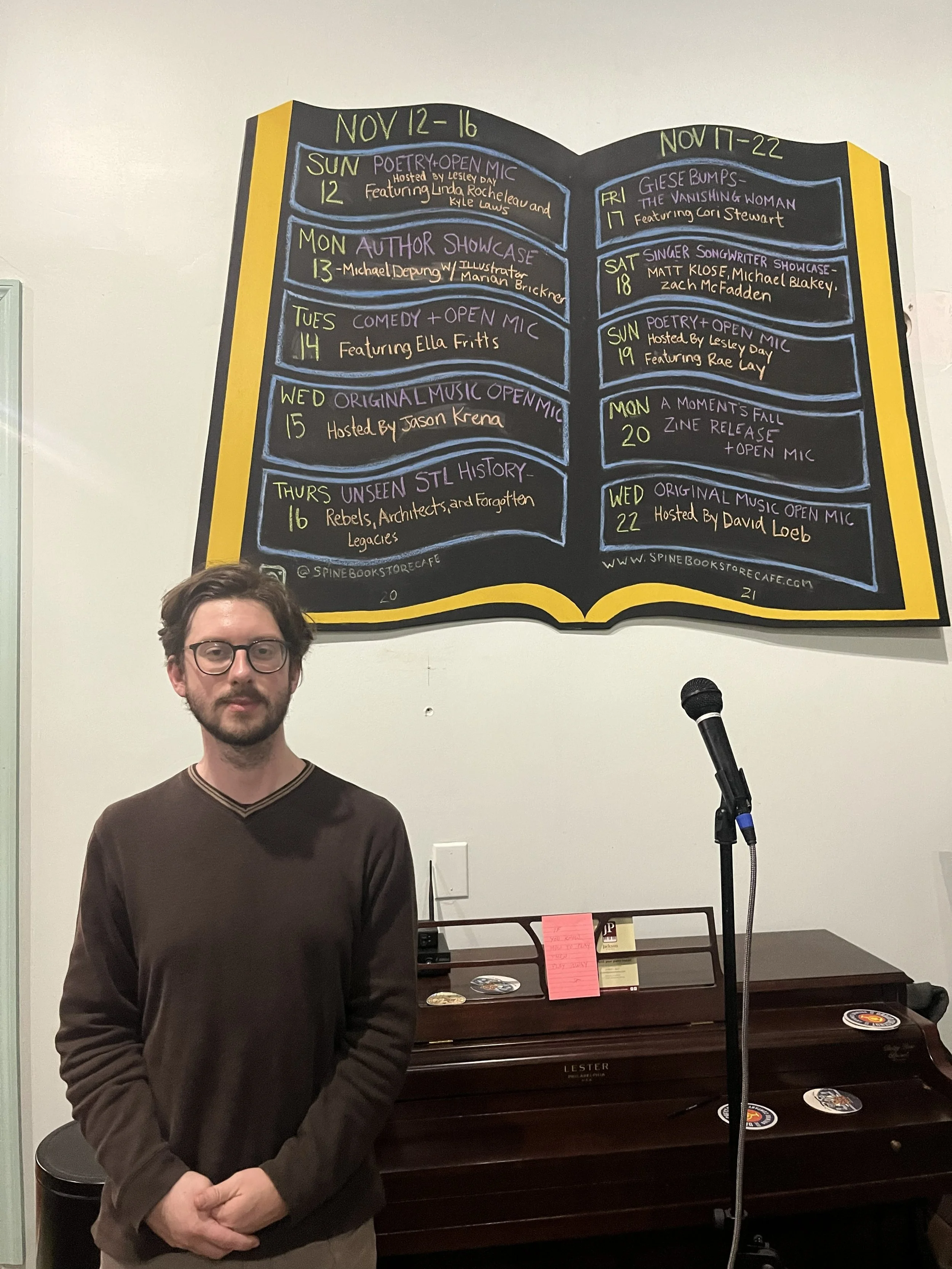
After presenting on James Eads How and the Hobo News, an early 20th-century migrant workers’ newspaper, at Spine Bookstore in St. Louis, 2023.
